Locations / Seattle, WA
Office access control in Seattle — for the companies that work alongside the giants, at a fraction of the overhead.
Seattle’s small and mid-size companies lease space downtown and in the Denny Triangle, in South Lake Union, Pioneer Square and Fremont, and across Lake Washington in Bellevue, Redmond and Kirkland, with more in Bothell, Tukwila and Kent. Most of those suites already run card access. GateStride keeps that system, moves people from badges to phones, cuts the per-person cost of running it, and keeps track of who has left each building.
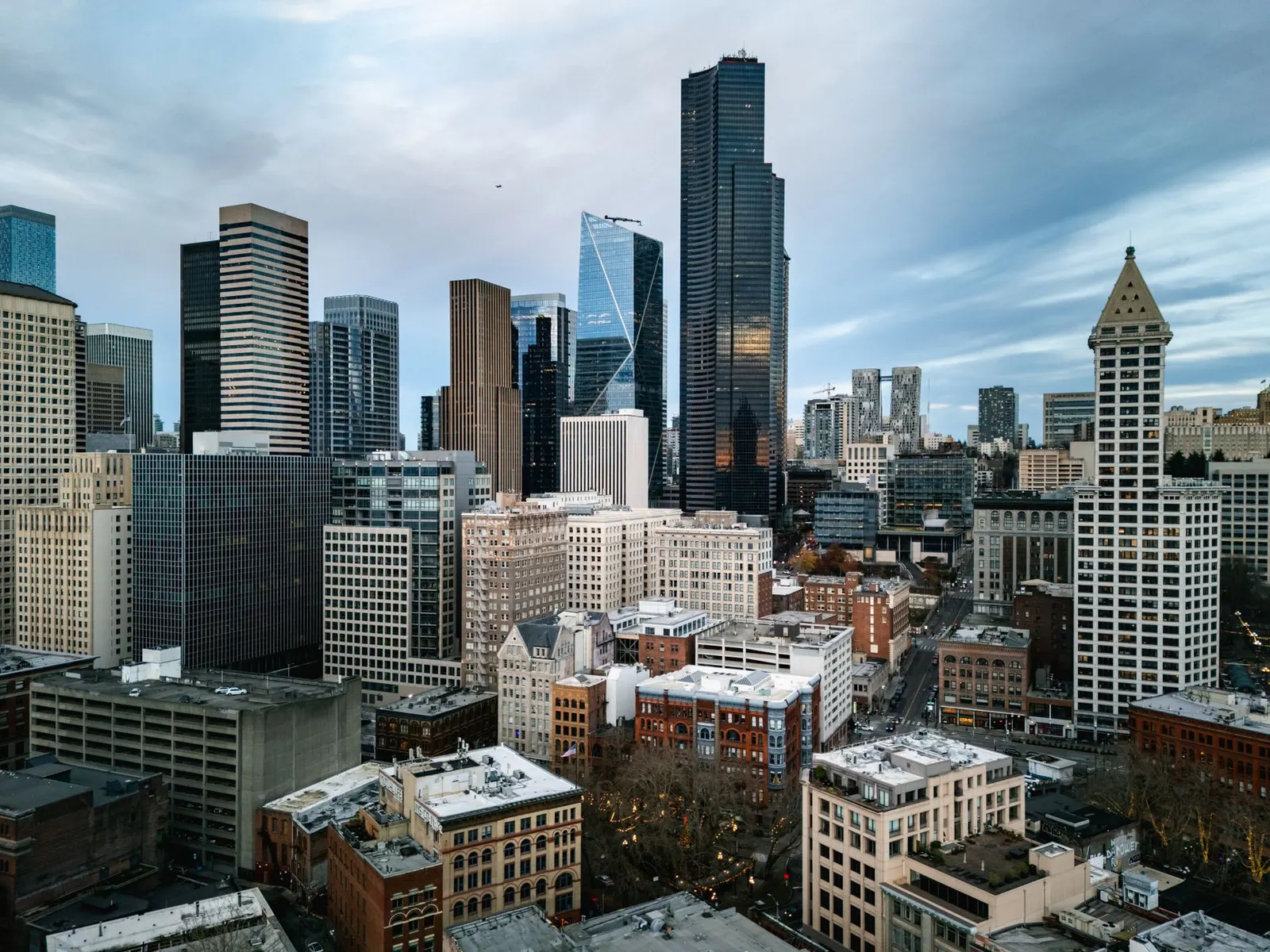
How Seattle-area office space is laid out
Office space around Puget Sound splits along the lake. On the Seattle side, the downtown core and Denny Triangle hold the multi-tenant towers; South Lake Union mixes newer mid-rises with life-science buildings; Pioneer Square, Fremont and Ballard offer older brick and timber buildings popular with smaller firms. On the Eastside, Bellevue’s downtown towers and the office campuses of Redmond, Kirkland and Bothell house technology and professional-services companies, many of them suppliers or partners to the region’s large corporate headquarters.
Big employers run their own campuses with their own security teams. The 10-to-500-person company next door usually does not: it leases a floor behind a landlord-controlled lobby and garage, or a whole older building in which it controls every door. Its suite system is often a few years old, inherited, and administered by whoever runs the office, usually alongside a dozen other jobs. That tenant layer is the one GateStride upgrades.
- Offices on both sides of the lake. Plenty of firms keep a Seattle office and an Eastside one, linked by a commute that can take far longer than the distance suggests. GateStride manages both from one screen, with a separate who-is-inside list for each location.
- Competing for staff with big employers. Smaller companies hire from the same pool as the region’s largest tech employers, and new hires expect their phone to open the door. Phone credentials deliver that on the hardware you already own.
- Snow days and smoke days. Occasional snow and ice can close roads in the hilly city, and summer wildfire smoke sends people home early. When the office closes mid-day, a live list of who is still in each building tells you who to check on.
Where Seattle offices overpay for access control
The cost of running access control in a Seattle office rarely arrives as one bill. It comes in licence renewals, user tiers, replacement fobs and the time somebody spends issuing and revoking them, and it scales with every hire.
Per-person fees
Cardholder, user or mobile-credential charges that rise with every hire, even though no door changed.
Badges that walk out
Lost, broken and never-returned cards and fobs, each one a purchase and a gap until it is disabled.
Office-manager hours
Issuing badges on day one, chasing them on the last day, and letting people in who forgot theirs.
The replacement quote
New readers, controllers, wiring and subscriptions proposed for a system that still works.
GateStride connects to the system you already own as a single integration user and manages your people itself, so staff who move to phone access stop adding per-person credential costs on the underlying system, and nobody needs a badge printed. Put your own numbers into the savings calculator to see what that is worth for your office, and check your vendor’s licence terms with your integrator.
Knowing who is still inside, in Seattle
Earthquakes are the long-term planning risk in Puget Sound, and many offices practise drop, cover and hold on, followed by an orderly exit and a headcount outside. After a real quake, nobody should go back up to look for a missing colleague who may already have left. A recorded exit for each person tells wardens who is accounted for and who is not.
The same logic applies to a routine fire alarm in a downtown or Bellevue tower, where many tenants empty onto the same sidewalks, and to the days when weather or smoke closes an office early and managers want to confirm everyone is out.
Most card systems log people coming in, not going out, because exits release freely. GateStride records who left from the phone they carry, without a swipe, and turns a fire drill into a one-tap roll call. How exit tracking works.
Exit tracking supports accountability. It is not a substitute for free egress, your evacuation plan or your certified fire and life-safety systems.
Rules that apply to Seattle offices
Before anyone touches a door, three things are worth knowing. This is general information, not legal or life-safety advice; confirm specifics with the agencies below and your own counsel.
Checking your installer is licensed in Washington
Washington does not issue a separate alarm-company licence. Low-voltage security and access control work falls under the Department of Labor & Industries’ electrical program: the company needs an electrical contractor licence with the Limited Energy System (06) specialty, which covers signalling and power-limited circuits including control systems, or a general (01) licence, plus an administrator certificate, and the people doing the work must be individually certified electricians or trainees. L&I also has a nonresidential security system specialty certificate. Use L&I’s “Verify a contractor” lookup to confirm an active licence and specialty. The scope is defined in WAC 296-46B-920.
Who enforces door and egress rules in Seattle
In Seattle, the Fire Department’s Fire Marshal’s Office enforces the fire code and the Seattle Department of Construction and Inspections (SDCI) enforces the building code. Seattle runs on an older code cycle than much of the country: the 2021 Seattle Fire Code took effect on November 15, 2024, and SDCI says adoption of the 2024-based Seattle codes will not be complete before May 2027. When someone quotes an egress or door-locking requirement, ask which edition it comes from. Bellevue, Redmond and other Eastside cities have their own departments. GateStride does not change door release.
Source: Seattle Department of Construction and Inspections: Seattle code adoption
Privacy and biometric law in Washington
Washington has a biometric statute, RCW 19.375 (passed in 2017). It bars enrolling a biometric identifier in a database for a commercial purpose without notice and consent, or a mechanism to prevent later commercial use; ordinary photos, video and audio are excluded. Separately, the My Health My Data Act (2023) defines biometric data more broadly, including imagery and voice, as consumer health data, and the Attorney General treats any violation as a violation of the Consumer Protection Act, enforceable by the AG and through private lawsuits. Both matter if you turn on face or fingerprint unlock.
GateStride’s default uses device credentials and non-biometric person detection, so no biometric data is collected. Facial recognition is optional, off by default, and offered only where it is legally compliant and you choose to enable it.
Works with the systems Seattle integrators install
You keep your vendor and your integrator. GateStride overlays Kantech EntraPass, Honeywell, LenelS2 OnGuard, Software House C•CURE, HID and Brivo by reading their events and calling their own unlock. See the integrations, the architecture, or how an upgrade compares with ripping everything out for a cloud platform. Puget Sound integrators commonly support platforms such as LenelS2, Software House, Genetec, AMAG, Gallagher, Brivo, Kantech and HID; if your office runs one of them, GateStride sits on top.
For Seattle security integrators
Puget Sound integrators look after a large base of office doors outside the big corporate campuses, from downtown suites to Eastside office parks. GateStride gives you an upgrade to bring to those customers without pulling a reader or controller: phone credentials, exit tracking and multi-site management on the system they already run. The account and the service relationship stay with you, the margin recurs, and partners are listed by city and platform.
Seattle’s security community meets through ASIS International Puget Sound Chapter #051 · Washington Burglar & Fire Alarm Association (WBFAA).
Questions from Seattle offices
- Does an access control installer need a licence in Washington?
- Yes, through electrical licensing rather than an alarm licence. The company needs a Labor & Industries electrical contractor licence, typically with the Limited Energy (06) specialty, and the technicians need individual certification. Check the company on L&I’s Verify a Contractor lookup.
- Does Washington’s biometric law affect GateStride?
- Not by default. GateStride’s standard setup uses phones and other device credentials and collects no biometric data. Facial recognition is optional and off unless you turn it on; if you do, RCW 19.375 notice and consent rules, and possibly the My Health My Data Act, need review with counsel first.
- We have a Seattle office and a Bellevue office. Can one person manage both?
- Yes. GateStride shows every door and site in one place, so an office manager on either side of the lake can add a new hire, revoke a leaver or see who is in each building without travelling between them.
- Do I have to replace my access control to use GateStride in Seattle?
- No. GateStride overlays the system you already run, reading its events and calling its own unlock. Your readers, controllers, locks, request-to-exit and fire release stay exactly as they are.
- Does GateStride have an office in Seattle?
- No. GateStride is software, managed remotely, so we serve the Seattle and Puget Sound area without a local office. The small node at each door is installed by a licensed security integrator, often the one who already services your system.
- Will it lower what we pay each month?
- It can, if you pay per-user or per-mobile-credential fees, buy replacement badges, or spend staff time issuing and revoking them. Use the savings calculator with your own invoices to see the figure for your office; if you pay none of those, the case rests on the features instead.
- Can we see who has left the building without anyone swiping out?
- Yes. Exits are recorded from the enrolled phone, watch or tablet people carry, while the door keeps releasing freely as it does today. That gives a live who's-inside list and a one-tap roll call during an evacuation.
See it on your Seattle doors
A short demo on the access control you already have — no rip-and-replace.
Sources
- https://www.law.cornell.edu/regulations/washington/WAC-296-46B-920
- https://seattle.gov/sdci/codes/changes-to-code/seattle-code-adoption
- https://lawfilesext.leg.wa.gov/Law/RCW/RCW%20%2019%20%20TITLE/RCW%20%2019%20.375%20%20CHAPTER/RCW%20%2019%20.375%20%20CHAPTER.htm
- https://www.atg.wa.gov/protecting-washingtonians-personal-health-data-and-privacy
- https://asispugetsound.com/about
- https://www.securitysales.com/business/wbfaa-members-now-own-a-city-with-new-program/
Last reviewed October 2026. Trademarks belong to their respective owners; GateStride is independent and not affiliated with or endorsed by any access-control manufacturer.