Locations / Washington, DC
Office access control in Washington, DC — less to carry, less to pay, nothing ripped out.
Washington’s offices fill the downtown core and East End, stretch east to NoMa and south to Capitol Riverfront and the Southwest Waterfront, and continue across the river to Rosslyn, Tysons and Reston and up to Bethesda and Silver Spring. Associations, law firms, consultancies and government contractors in those buildings mostly have card access already. GateStride adds phone unlock and a record of who has left, on the system they own, and trims what it costs to run.
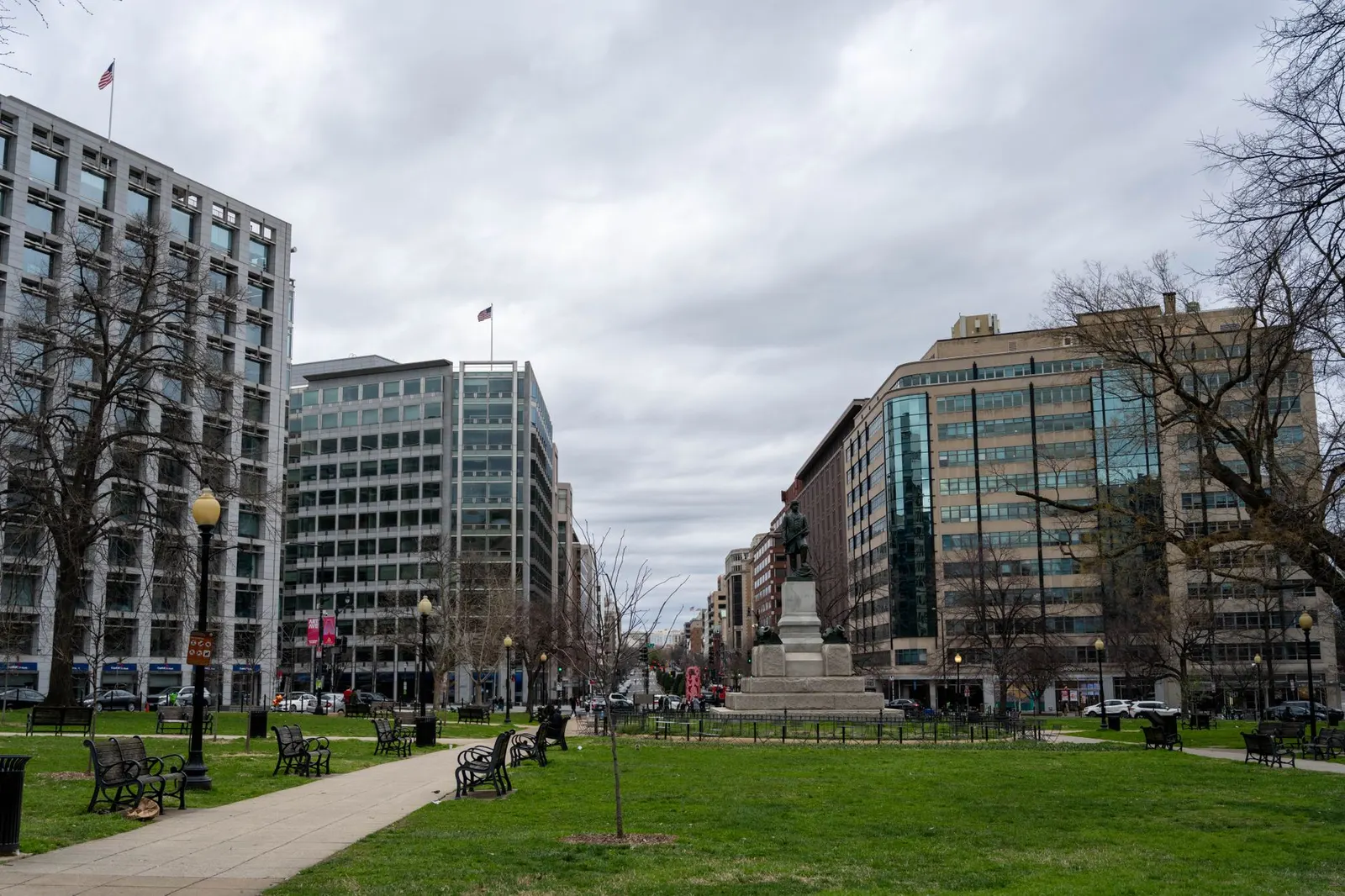
How the Washington office market is laid out
Inside the District, the traditional business district runs from Farragut and K Street through the East End toward Penn Quarter, with newer office neighborhoods in NoMa, Capitol Riverfront near the Navy Yard and the Southwest Waterfront. Because the city’s building-height limit keeps towers low, offices here are typically broad buildings of a dozen or so floors rather than skyscrapers, with many tenants per building and frequent turnover of suites. Across the Potomac, Rosslyn, Ballston, National Landing, Tysons and Reston hold a large share of the region’s office space, and in Maryland, Bethesda, Silver Spring and the I-270 corridor toward Rockville and Gaithersburg do the same.
Professional services and government work dominate. Trade associations, nonprofits, law and lobbying firms and federal contractors lease suites in multi-tenant buildings, where the landlord runs the lobby desk and garage and the tenant runs its own suite doors. Contractors working in federal space follow the government’s own credential rules there; their commercial offices are usually ordinary tenant suites with an access system the company administers itself.
- Three jurisdictions, one company. A firm with a District headquarters and offices in Virginia and Maryland deals with three sets of local rules and often three generations of hardware. GateStride manages people across every site from one place, with a separate who’s-inside list for each.
- Metro, bikes and full hands. Many staff arrive by Metro, bike or on foot, carrying bags and laptops. Walk-up phone unlock opens the suite door as they reach it, so nobody juggles a badge on the way in.
- Interns, fellows and project teams. Washington runs on seasonal interns, fellows and contract project staff. Phone credentials can be granted for a set period and expire on their own, with no badge to print or retrieve.
Where Washington offices overpay for access control
For a Washington association or consultancy, access control rarely shows up as one line item. It is licence renewals, per-user charges, badge reorders and staff time, and all of them climb with headcount.
Per-person fees
Cardholder, user or mobile-credential charges that rise with every hire, even though no door changed.
Badges that walk out
Lost, broken and never-returned cards and fobs, each one a purchase and a gap until it is disabled.
Office-manager hours
Issuing badges on day one, chasing them on the last day, and letting people in who forgot theirs.
The replacement quote
New readers, controllers, wiring and subscriptions proposed for a system that still works.
GateStride connects to the system you already own as a single integration user and manages your people itself, so staff who move to phone access stop adding per-person credential costs on the underlying system, and nobody needs a badge printed. Put your own numbers into the savings calculator to see what that is worth for your office, and check your vendor’s licence terms with your integrator.
Knowing who is still inside, in Washington
Washington offices close and empty for reasons most cities never deal with: snow days that shut down the region, major events and demonstrations that close streets, and building-wide alarms in densely tenanted buildings. When a company sends people home early, the person locking up needs to know who is still inside, not just who badged in that morning.
In a fire alarm, tenants in a low, wide building stream out of several stairwells onto different streets. A list of who has left, recorded from each person’s phone, lets a floor warden confirm their team at the meeting point without calling around.
Most card systems log people coming in, not going out, because exits release freely. GateStride records who left from the phone they carry, without a swipe, and turns a fire drill into a one-tap roll call. How exit tracking works.
Exit tracking supports accountability. It is not a substitute for free egress, your evacuation plan or your certified fire and life-safety systems.
Rules that apply to Washington offices
Before anyone touches a door, three things are worth knowing. This is general information, not legal or life-safety advice; confirm specifics with the agencies below and your own counsel.
Checking your installer is licensed in District of Columbia
Our research did not confirm which District licence covers companies that install or service access control, so we do not summarise one here. Before anyone works on your doors, ask the installer which licences they hold for security and low-voltage work in the District and confirm them with the DC Department of Licensing and Consumer Protection (DLCP). If your offices are also in Virginia or Maryland, check those states’ requirements separately.
Who enforces door and egress rules in Washington
The DC Department of Buildings (DOB) administers the DC Construction Codes, Title 12 of the DC Municipal Regulations. DOB’s code page states that the 2017 DC Construction Codes, based on the 2015 International Code Council model codes, took effect on May 29, 2020, and lists the fire code among the adopted codes. Check with DOB whether a newer edition has since been adopted, and which office reviews fire-related changes to door locking. Any change to how a door releases goes through your landlord and DOB. GateStride does not change door release.
Privacy and biometric law in District of Columbia
Our research found no standalone biometric privacy statute in the District. DC’s data breach law, D.C. Code 28-3851 and following, does define personal information to include biometric data such as fingerprints, voice prints and retina or iris images used to authenticate identity, so breach-notification duties apply to stored biometric templates. Phone-based unlock does not collect biometric data; if you ever enable optional facial recognition, review it with counsel.
Source: D.C. Code 28-3851
GateStride’s default uses device credentials and non-biometric person detection, so no biometric data is collected. Facial recognition is optional, off by default, and offered only where it is legally compliant and you choose to enable it.
Works with the systems Washington integrators install
You keep your vendor and your integrator. GateStride overlays Kantech EntraPass, Honeywell, LenelS2 OnGuard, Software House C•CURE, HID and Brivo by reading their events and calling their own unlock. See the integrations, the architecture, or how an upgrade compares with ripping everything out for a cloud platform. Integrators in the Washington region commonly support platforms such as LenelS2, Genetec, AMAG Symmetry, Brivo, Hirsch/Identiv and HID; if your office runs one of them, GateStride sits on top.
For Washington security integrators
Integrators in the Washington region typically cover the District, Northern Virginia and Maryland, and a good part of that book is commercial tenant suites with working hardware. GateStride gives you a recurring upgrade to sell into those accounts: phone unlock and exit tracking with no replacement project, margin on every site each month, and a client relationship that remains entirely yours. Our partner directory lists integrators by city and by the systems they install.
Washington’s security community meets through ASIS International (find the local chapter) · Electronic Security Association (ESA).
Questions from Washington offices
- Who licenses access-control installers in Washington, DC?
- Confirm with the DC Department of Licensing and Consumer Protection which licences apply to security and low-voltage work in the District, and ask your installer for theirs. If the same company also works on your Virginia or Maryland offices, check those states’ requirements too.
- Can GateStride cover our offices in DC, Virginia and Maryland together?
- Yes. GateStride is software managed remotely, so one account can cover sites in all three, each on its own existing system. You manage people in one place and see a separate who’s-inside list per office. Local hardware work is still done by a licensed integrator.
- Our staff need federal PIV cards for client sites. Does GateStride replace them?
- No. Federal facilities set their own credential rules and GateStride does not change them. It works on the access system your company runs in its own commercial office, so staff can use their phone there while carrying whatever their client sites require.
- Do I have to replace my access control to use GateStride in Washington?
- No. GateStride overlays the system you already run, reading its events and calling its own unlock. Your readers, controllers, locks, request-to-exit and fire release stay exactly as they are.
- Does GateStride have an office in Washington?
- No. GateStride is software, managed remotely, so we serve the Washington, DC area without a local office. The small node at each door is installed by a licensed security integrator, often the one who already services your system.
- Will it lower what we pay each month?
- It can, if you pay per-user or per-mobile-credential fees, buy replacement badges, or spend staff time issuing and revoking them. Use the savings calculator with your own invoices to see the figure for your office; if you pay none of those, the case rests on the features instead.
- Can we see who has left the building without anyone swiping out?
- Yes. Exits are recorded from the enrolled phone, watch or tablet people carry, while the door keeps releasing freely as it does today. That gives a live who's-inside list and a one-tap roll call during an evacuation.
See it on your Washington doors
A short demo on the access control you already have — no rip-and-replace.
Sources
- https://dob.dc.gov/page/dc-construction-codes
- https://code.dccouncil.gov/us/dc/council/code/sections/28-3851
- https://www.bls.gov/eag/eag.dc_washington_md.htm
Last reviewed October 2026. Trademarks belong to their respective owners; GateStride is independent and not affiliated with or endorsed by any access-control manufacturer.